
Understand with real-time data how people move through your spaces
With our analytics tool, you will learn how your customers move, where they dwell, and which areas are the most popular.
- Perfect product placements
- Better shopping experiences
- Measurable marketing campaigns
- Imagine knowing exactly where people spend time on your floor, how long they stay, and when the peaks occur.
- That's exactly what ANALYSIT makes possible.
- With the ANALYSIT Counting System, you gain real-time data on how many people are on your floor and how long they stay in each zone - including history over 730 days and peak times. You can align space planning, signage and staffing with it, improve space utilisation and reduce waiting times.
Live count of people present - anonymous, in one-minute resolution
Presence map per grid cell and dwell time per zone
Comparisons across buildings, floors and zones
Where decisions about space go wrong:
Gut-feeling decisions
Layout, routing and signage all influence how long people stay, how easily they find their way, and where congestion builds.
Better shopping experiences
Perfect product placements
Measurable marketing campaigns
The problem: Few operators have reliable numbers on how their spaces are actually used. Instead, they improvise-relying on experience, gut feeling, and what has always worked before.
But customer behavior changes. Peak times shift. Attention wanders.
The result?
Ads miss their mark.
Customers walk past your best products.
Bottlenecks cause frustration and dissatisfied customers.
- Customer Dwell Areas
- Bottlenecks
- Used/Ignored Paths
What you need is clear data:
- Where do your customers spend the most time?
- When do bottlenecks form?
- Which paths are truly used-and which are ignored?
With this knowledge you can use your space more efficiently, reduce wait times - and base decisions on numbers instead of assumptions.
Online, everyone measures every click. On the floor, the same is missing. behavioral data of your customers
With online services it’s long been standard: every click is tracked, every movement analyzed. You know exactly how many people visit your website, how long they stay on a page, when they leave, and at what times the most traffic occurs.
Meaning: Every decision is data-driven.
Structure, order, timing - nothing is left to chance.
And on your floor?
This clarity is often lacking. Because you lack the data.
But what if you had the same clarity on your floor as you do online?
What if you could see exactly how many people are in which zone, how long they stay - and when certain areas are particularly in demand?
Imagine if you could…
… optimize your space and product placements psychologically because you know where your customers stay the longest.
… manage marketing efforts, staff planning, and opening hours based on real-time and historical data.
… shorten wait times - and ease congestion.
It sounds like online tracking-only offline.
And that is exactly what ANALYSIT makes possible.
Control product placements, pathways, and marketing efforts based on data with ANALYSIT
With the ANALYSIT Counting System, you see in real time how many people are on your floor - anonymously and in one-minute resolution. Mask detection is available as a licensed extension. Employees can be excluded from the count if desired.
Our 3D sensors anonymously capture how your floor is used: how many people are in each zone, how long they stay, and which areas are most frequented - all in real time and GDPR-compliant.
Historical overviews show you visitor numbers on a daily, weekly, monthly, and yearly basis. You also see when particularly many or few visitors came.
Additionally, you can directly compare the total footfall of individual sites and sensors - for example, by time period or building.
For deeper insights, we also offer a space analysis. That means we provide you with concrete evaluations and recommendations for planning your space. We look at the most heavily frequented areas, the dwell time per zone, and spots that are barely used.
Your benefits with ANALYSIT:
Design space around actual use:
The presence map shows which grid cells are used heavily and which are barely used. That lets you plan changes on numbers.
Better ad placements:
Deploy your marketing measures where they truly have an impact. This way you measure and increase your return on marketing investment.
Spot peaks and bottlenecks:
The data shows when and where people build up - so you can adjust staffing, access and visitor routing in time.
Dwell time per zone:
See how long people stay in a zone - at a resolution from one minute to a full day, looking back over 730 days.
Compare multiple sites:
Compare buildings, floors and zones with one another and see how each area is actually used.
Efficient resource planning:
Identify when more staff is needed, optimise your staffing schedule and reduce waiting times.
Value rental space:
Value rental space on actual footfall instead of estimates.
By the way:
The ANALYSIT Counting System suits airports, smart buildings, museums, staff restaurants, leisure parks and public transport - wherever spaces with foot traffic are planned and operated. Learn more about the application possibilities of ANALYSIT here.
With sensor data, you can make informed decisions about marketing efforts, product placements, and pathways.
- People find their way around your space more easily.
- Congestion and waiting times go down.
- Your decisions rest on numbers.
Four steps to reliable numbers


Project Planning
We introduce you to the ANALYSIT Counting System and define your project's key parameters. Together, we determine how many sites and zones should be equipped, which sensors are needed, and assess your technical infrastructure. Based on these insights, we prepare a tailored proposal designed for your success.
Sensor Selection & Pre-Configuration
After project approval, we source your sensors and pre-configure them for your environment-so they're ready to install straight out of the box.

Delivery & Installation
Your sensors arrive via secure shipping. Installation is quick and easy-you can install them with your own team or have our experts assist you. We'll provide clear step-by-step installation guides and optional remote support.

Dashboard Activation
Once installed, we connect remotely to finalize setup and customize your dashboard. From day one, you'll see your live and historical visitor data-fully GDPR-compliant, clearly visualized, and ready to drive your business decisions.
How We Work Together
It all starts with a free initial consultation. We walk you through how our data is collected and demonstrate how the system fits your business. Then, we build a clear use case plan and project roadmap so you always know the next steps. We'll also outline a preliminary budget and define how many locations will be integrated.
About ANALYSIT
At ANALYSIT we help you understand how your spaces are actually used. Our data gives you a basis for space planning, staffing and opening hours - as a certified Xovis partner, with sensors, configuration, operation and support from a single source.
Our mission: give operators of physical spaces the same clarity that online services have relied on for years - without cameras and without compromising data privacy. We deliver precise, anonymous numbers on how spaces are used, so you can make better decisions.
Better decisions:
Reliable numbers for space planning, staffing and opening hours.
Happier customers:
Shorter wait times and fewer overcrowded areas.
Greater efficiency:
Optimized staffing based on real-time data
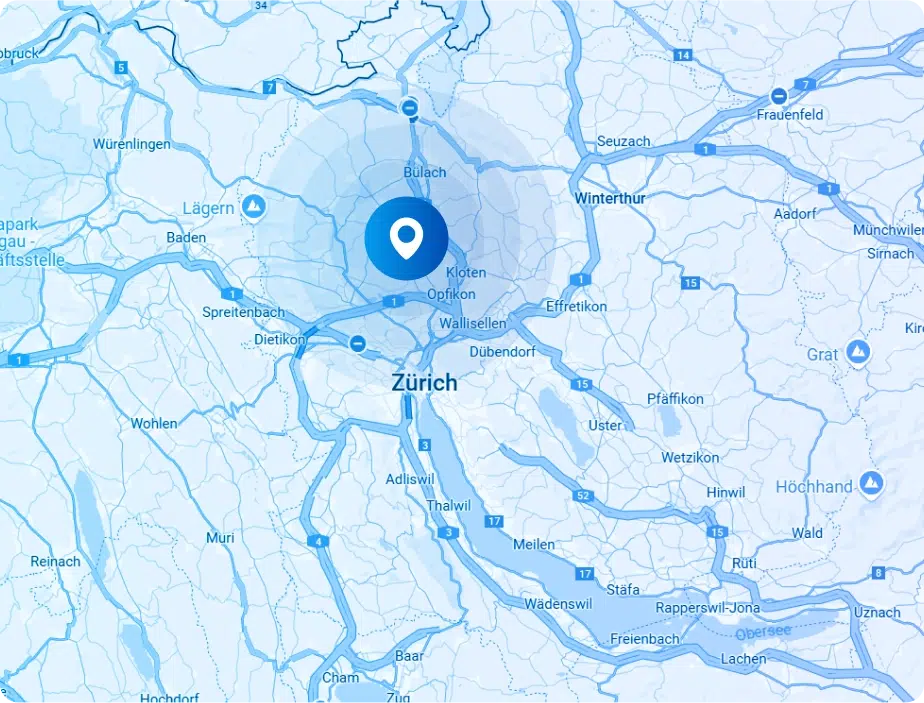
Our Headquarters in Zurich
We're based in Rümlang, Canton Zurich. Thanks to our fully digital processes, we work with clients worldwide-whether by phone, video call, or on-site visits. While in-person meetings are always welcome, they’re not essential. Let’s unlock your data potential-in Switzerland and beyond.
Frequently asked questions about people counting and space analytics
Yes, the ANALYSIT Counting System is fully privacy-compliant. All collected data is anonymized-no personal data is stored or processed. The system meets the requirements of the EU General Data Protection Regulation (GDPR) and the Swiss Federal Act on Data Protection (FADP).
Our solution is based on Xovis 3D sensors, which are certified with an E-Privacy seal from Germany. These sensors are edge-processing devices, meaning all data processing happens directly on the device. No camera footage is stored or transmitted-only anonymous movement metadata is generated. This ensures no personal identification is possible.
The term „camera“ can be interpreted differently, but generally refers to devices that capture photos or videos.
Xovis sensors are edge-processing devices: all image processing happens directly on the sensor in real time. No photos or videos leave the sensor during operation-only anonymous X/Y coordinates or event triggers are transmitted, such as when a person crosses a virtual line in the entrance area.